

Our thoughts for the New Year: a little works better than a lot

The first few days of the year are always filled with a media barrage of advice. You can’t go on the interweb, open a magazine or turn on the telly, without some omniscient panjandrum telling you to do a dozen worthy things. Eat less, until you look like a prisoner in the Soviet Gulag. Run like a marathon athlete. Fill your mind with worthy moral projects and take on so many new tasks that you become a Different Person. All by January 10th. We know none of this ever works, because if it did the experts would not have to repeat themselves every year. And the reason it doesn’t work is because it’s asking too much of people.

It was the late great Dr Michael Mosley who realised this. In his eminently readable work Just One Thing: How simple changes can transform your Life [1] He sets out a whole slew of small ideas which people can achieve rather than big things which they can’t. If you want to discover what they are read the book. But it inspired us to go around the mighty offices of the Learning Science and Society Headquarters here in beautiful Croydon and ask people about their ideas for New Years resolutions which will stick. Here are our findings:

Commuting get off one stop earlier than normal, and walk. OK if your stops are only a quarter of a mile apart But what if you live in Haywards Heath and work in Croydon? You’d have to walk from Gatwick. Our verdict: good if sensibly applied

Dry January which most people interpret as no booze from New Years day until Valentines Day. Feasible and- we have actually done it. But what if your local Toby Carvery is offering a crazy special at £6 a head? Are you really going to sit there and drink water?

Declutter a cupboard Makes space and is exercise of a sort provided you don’t gash your head on an exposed door and have to have the splinters removed in Croydon General Hospital. Plus the local charity shops will just love all those old mini discs, pencils, tatty files , keyboards, adding machines, unused 1997 diaries, abacuses and stone tools which you find. But what if you don’t have a cupboard?

Learn the name of a colleague whose monniker you have forgotten/never knew anyway Ok as far as it goes but could be creepy. Being on the Board, we are used to this all the time and with practice it’s not as tricky as it looks.

Read one page from a book each day Ok slows you down and broadens the mind But what if the book is Mein Kampf or the Croydon Trades Directory for 1989 ? Verdict: choose carefully

Give someone your full intention for 60 seconds Oh come on, these are meant to be achievable!

So here are our conclusions, to sit alongside those of the great Dr Mosley. Da quod jubes et jubes quod da, we say (give what you command and command what you give) A favourite catchphrase which we share with St Augustine of Hippo. On which note we will simply wish you all a successful 2026.

Our thanks to the staff of Croydon General Hospital and apologies for the extra work we caused them

[1]Mosley, Michael. Just One Thing: How Simple Changes Can Transform Your Life. Short Books / Hachette UK, 2022.

#health #diet #New Year
We offer a massive and unconditional apology for Nitrogen

We think we owe you a truly massive overwhelming  apology, gentle reader. And this is why.

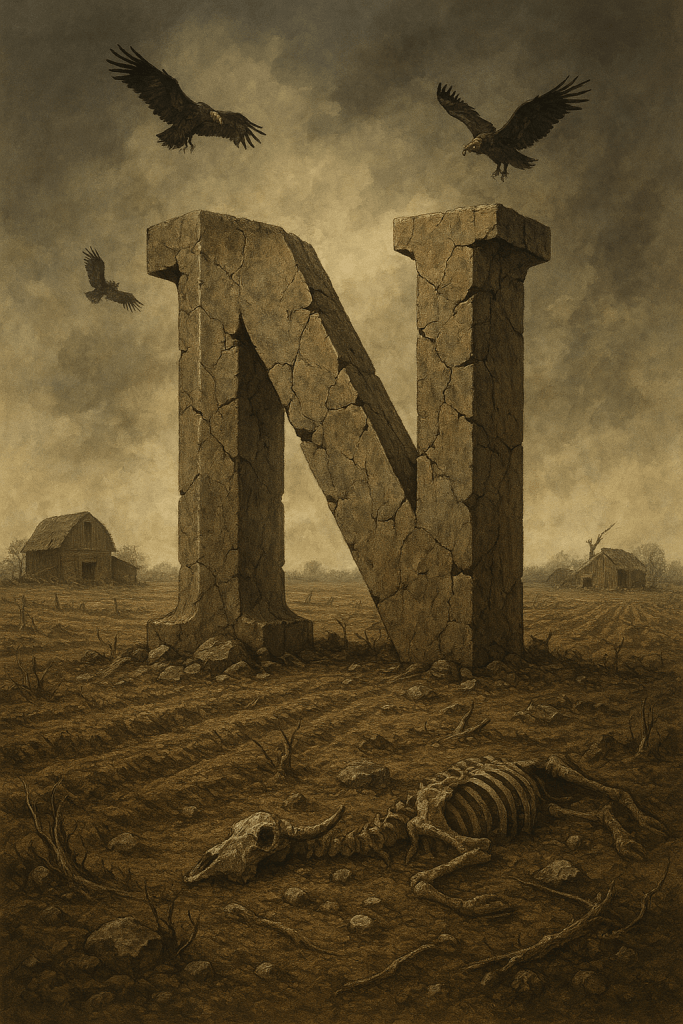
“Will the world end with a bang or a whimper?” is a question we’ve covered before here. We’ve even mentioned a  few possibilities such as  magnetic flips ,exploding volcanoes and more  insidious effects like  pollution and pandemics.  (LSS passim)Yet it was while researching another topic entirely that we came across a wholly unexpected and entirely man-made problem that we thought you should know about: Nitrogen, [1] [2]and its derivative compounds which has been unleashed on an unprepared world in uncontrolled quantities for over a century. The reason it’s rising so fast is simple: we are manufacturing and releasing unprecedented quantities of reactive nitrogen—fertilisers, manure emissions, industrial by‑products—far beyond anything the planet’s natural nitrogen cycle ever evolved to handle.

Why so much? Because the Haber–Bosch process unlocked a torrent of synthetic nitrogen, and agriculture embraced it as a miracle. Global production of reactive nitrogen has soared to many times its pre‑industrial level. Locally, this can boost yields, but it comes with a hidden price: soils become chemically dependent, losing the microbial communities that once fixed nitrogen naturally. Excess nitrogen washes into rivers, fuelling algal blooms and dead zones; it volatilises into nitrous oxide, damaging the ozone layer; it accumulates in ecosystems, favouring a few aggressive species while starving others. And things are never so bad that they don’t get   worse. Nitrous oxide is  the quiet heavyweight of greenhouse gases.  molecule for molecule, it traps far more heat than carbon dioxide and lingers in the atmosphere for over a century. It’s also the single largest ozone‑depleting emission humanity still produces. And yet most people barely register it.  So what looks like abundance at the farm gate is, at planetary scale, a metabolic overload.

And this is the deeper tragedy: millions of farmers, each trying to solve a local problem—how to feed crops, how to secure a harvest—collectively drive a global destabilisation of the nitrogen cycle. We’ve built a civilisation addicted to excess nitrogen, and the system now expects those inputs just to function. The long‑term risk is that we push soils, waterways, and atmospheric chemistry past thresholds that cannot easily be reversed. What began as a triumph of human ingenuity has become a planetary dependence, and the bill for that dependence is only just beginning to arrive. A silent catastrophe of soil degradation, desertification, wetland collapse (LSS 28 5 24),biodiversity loss from nutrient overload, and fisheries collapse.

And  now for our apology, gentle readers.  For several years now we have been repeatedly warning you of the dangers posed by antibiotic resistant bacteria and climate change. We had not a single idea about this nitrogen crisis building up all around us. None whatsoever, We profoundly and unreservedly apologise to all of you-readers, contributors researchers and hard working staff, even the ones in HR. And we say this-never will such an oversight happen again in this mighty organisation. But do not be alarmed.  From now on we will search the world ceaselessly to bring you news of fresh perils, unexpected lethal dangers which may be lurking ready to wipe us all out Or if not that, at least reduce the handful of survivors to subsistence-level barbarism in a lawless, violent post-apocalyptic world.  We think we may even have uncovered a few already. Follow us if you want to know more about what they are.

[1] Anthropogenic-driven perturbations on nitrogen cycles and interactions with climate change (2024)Gong, Kou‑Giesbrecht & Zaehle (2024)
Published in Current Opinion in Green and Sustainable Chemistry. click:Anthropogenic-driven perturbations on nitrogen cycles and interactions with climate changes – ScienceDirect

[2] Alteration in nitrogen cycle and its contribution to climate change: a review (2025)Anand et al. (2025) click:2Alteration in nitrogen cycle and its contribution to climate change: a review | Proceedings of the Indian National Science Academy

#nitogen #agriculture #nitrous oxide #pollution #climate change #disaster

Has Donald Trump just brought a World Government much nearer?

Last year we ran a series exploring the pros and cons of a World Government.(LSS 8 1 25 et seq) The general consensus was that it was a nice idea in theory: but utterly unattainable in practice. And the reason our critics gave was very strong: the incredibly firm attachments of people to their national states, which had served them very well up until now. “Sovereignty-it’s all about sovereignty,” they averred, “the right to make our own laws, and defend our own frontiers.”

The recent  actions of Mr Trump in Venezuela have dealt that concept a heavy blow. We are ignorant of Mr Trump’s reasons, and lack the learning to judge the legality or the policy implications of his deeds. We know even less about Mr Maduro and his fitness to govern.  But we do know that it  is quite easy for a large power to enter the territory of a supposedly sovereign state. To take that state’s leader and to put him on trial for malfeasance in office, as though he were a provincial governor in an empire. And if this can happen to a country the size of Venezuela , it can happen to any nation. We ask: in such circumstances, what use is the concept of sovereignty as a practical guide to human action  For all except the three very largest powers, Russia, China and the United States of America.

Citizens of lands with incomplete sovereignty will notice this difference in practice. If a businessman wants a law changed, will he attempt to influence his local government-or save time and address the real centre of power? Will an ambitious lawyer   find her career served best in her native province? Or should she  change her dress, language and manners to thrive in the Imperial Capital? The same choices will confront many-soldiers, sports professionals, entertainers…..Each choice will weaken attachments to the local,  and strengthen the central. It will be slow at first, but the identity and culture of the old nation state will atrophy. At best they will be like the former City States of Italy, Venice and the others, venerable relics of lost dominion. . At worst, quaint tribal lands, endlessly repeating their plays and dances for the amusement of tourists, and selling quaint fabrics and pottery to make ends meet. No doubt ethnic jealousies and wars will flare between them, as they still do in lesser nations in various parts of the world. But these will be essentially tribal, and should suit the dominant Power.  For people fighting among themselves can never unite to threaten its overarching force.. But their days of commanding the unconditional loyalties of the brightest, the most hard working, the most ambitious, will be numbered.

We didn’t really believe our  World Government theory much ourselves after  we wrote it. .  But now the number of objections to our theory has suddenly  dropped from 193 to 3. Which of that three  finally brings it true remains to be seen; but has just become more  likely that  one of them will.

#united states of america #donald trump #china #russia #venezuela #sovereignty #international relations

AI stocks: boom or bubble?

Believe us: last week our favourite AI system made two dreadful errors. It blithely assured us that the actor Robert Shaw (he of A Man for All Seasons and Battle of Britain) was the father of actor Martin Shaw (he of The Professionals and Judge John Deed). He wasn’t. It also credited the song Manhattan to Irving Berlin. Wrong again: the writers were Richard Rogers and Lorenz Hart. Minor peccadillos you might think: and it apologised afterwards in a slightly brash thanks, I’ll-do-better-next-time sort of way. But we are not assuaged: Read this from the excellent Heather Stewart of the Guardian from her piece The cost of AI slop could cause a rethink that shakes the global economy in 2026: [1]

Police officers in Heber City, Utah, learned to manually check the work of a transcription tool they were using to draft write-ups from bodycam footage after it mistakenly claimed an officer had turned into a frog. Disney’s The Princess and the Frog was playing in the background.

Even for big fans of AI, and we count ourselves among its biggest, there are worries about its accuracy. And these could have consequences for us all. Heather calls two hostile witnesses: Ed Zitron and Cory Doctorow, whose views of AI are considerably more jaundiced than our own. The essence of their arguments is that the companies involved are not profitable. The cost of their operations far exceeds current and future revenue streams. That there is too much borrowing and too much leverage about. Fans of that excellent book 1929 by Andrew Sorkin[2] will recognise eerie echoes of the world of the 1920s when radio was the new technology, sparking a colossal boom in stock valuations and hyper-over-borrowed leverages. We all know how that ended. And the reast of Heather’s article descants on the similar medium term risks to us all from this bubble of our own times; and the consequences these may entail.

So will the bubble burst, shattering our comfortable lifestyles and throwing us back to begging buddies for a dime? John Plender for the FT mounts an admirable summary of the situation in this article for the Financial Times. [3] Like the sagacious thinker he is, he examines the evidence cautiously, and advises of probabilities and possibilities, avoiding definite predictions. You may need to overcome the paywall: but our reading of it suggests that if interest rates start to rise . get worried. We are LSS do not offer financial advice, nor economic predictions. But we have read our History and our Economics. And discovered that everyone who says “it’s different this time” is nearly always wrong.

[1]https://www.theguardian.com/business/2026/jan/04/ai-reality-growing-economic-risk-2026

[2]Sorkin, Andrew Ross. 1929: Inside the Greatest Crash in Wall Street History—and How It Shattered a Nation.

[3]https://www.ft.com/content/7987310a-5c90-4976-b730-3559502006e2?shareType=nongift

#AI #finance #stocks and shares #economics #technology #rogers and hart #martin shaw #computers

Devi Sridhar on weight loss drugs: another class in careful thinking

If one thing has captured the zeitgeist this year , it’s weight loss drugs. You know the ones like semaglutide which mimic the effects of the hormone GLP-1. Everyone’s talking about them, half of everyone’s thinking of trying them, everyone knows someone who has started a course. Certainly an up-to-the minute, contemporary cutting edge (that’s enough adjectival phrases-ed) blog like LSS cannot afford to ignore them. But what to think? Who has the wisdom, the learning, the cool balanced judgement to advise, consult and warn?

The answer of course is Professor Devi Sridhar, whose sagacious thoughts we have channelled here before (LSS 3 4 25;23 8 24) on matters as diverse as antibiotics and how to read things you find on the Interweb. Writing in the Guardian[1] she presents not only a balanced view of the pros and cons, she acknowledges the complexity of the subject. In this she echoes the methods of another writer we have admired here. Simon Kuper (LSS 28 5 25)

And so she notes the advantages and disadvantages of these new drugs- what happens when you stop taking them? -is one caveat among many which she offers us . She smiles at The incipient war between the pharmaceutical companies who want to flog you these things, and the vast food and catering industries who want to flog you things which will make you fat. And above all the awful dilemma faced by decent rational people such as the World Health Organisation. Who know the real problem of obesity is rooted in poverty, ignorance, conspicuous consumption and other cultural tropes which reveal such unflattering truths about humanity. But who nevertheless have come to feel, reluctantly, that the new drugs offer the only practicable solution to the epidemic of obesity that threatens public health world wide. Amd perhaps this is the clearest cognitive lesson of all which she offers. For it echoes the doctrine of the great John Maynard Keynes who stated: “when the facts change, I change my mind. What do you do sir?”

A worthy doctrine for Whigs, rationalists and progressives of all shades, everywhere.

[1]https://www.theguardian.com/commentisfree/2025/dec/31/world-health-organization-anti-obesity-jabs-2025?CMP=Share_iOSApp_Other

[2]https://uk.news.yahoo.com/weight-loss-jabs-conditionally-backed-135200252.html

#obesity #public health #weight loss #poverty #lifestyle

Two New Year Cocktails from 2020: we can’t improve on them

December 31 2020: it seems such a long time ago! It was the year Joe Biden had defeated Donald Trump to win the Presidency of the United States. The year a COVID-19 ravaged world was waiting for the first vaccines. And our already-growing pool of loyal readers was was waiting in addition for our advice about what to do for cocktails on what was going to be a rather restricted New Years Eve festival. And here is what we wrote in a piece titled Two Champagne Cocktails for New Year-Even if You’re Staying In:

Well, New Years Eve has always been a traditional time for fun and japes and conga lines-and lots and lots of champagne. Sadly, old Mr Covid-19 is going to crimp that this year, and by more than a little! But, do not despair, good reader. We at LSS have a couple of delicious champagne cocktail recipes for you to try as the big countdown to the glorious hour begins.

French ’75

Supposedly named after a powerful piece of Gallic field artillery, this is a fun sharpener with quite a slug of our favourite spirit-gin. The lemon and caster will give it the feel of a sparkling version of that old LSS favourite Between the Sheets. So, adapted from from Hamlyn‘s The Ultimate Cocktail Book:

Half fill a tall glass with cracked ice. Add 1 measure of good dry gin, the juice of half a fresh lemon, one teaspoon of caster sugar, and chilled champagne. These days Bollinger or Veuve Clicquot are perfectly acceptable, unless you live in somewhere like Monaco. You can decorate this one well with orange, lemon or lime slices to give that real party feel.

The Bellini

Most readers of LSS will be more than familiar with Renaissance Art, and the works of Giovani Bellini in particular. We know this from our focus groups. So it may come as no surprise that this one was named after the eponymous author of such works as St Jerome in the Desert, Christ Blessing and St Francis in Ecstasy. We are a bit unsure about that last one; surely a small tipple before evensong would have been sufficient? Anyway, once St Francis had come back down he, and you, could well have enjoyed the following. Again it is from our immortal Hamlyn, which is to us what Das Kapital is to the followers of Karl Marx.

Take a large, robust wineglass. Add two measures of fresh peach juice. Add four measures of chilled champagne and a dash of grenadine. Hamlyn recommends peach slices to decorate. We say: use your imagination, it’s New Year’s Eve!

You can read the full histories and more about these cocktails below via Wikipedia. But don’t forget, Knowledge and objective learning are now in deep, deep danger. Wikipedia is one of the best guardians of truth that we have. And so we earnestly beg you to think how much you can donate to this marvellous resource. They too must survive another year: details below in the links.

French 75 (cocktail) – Wikipedia

Bellini (cocktail) – Wikipedia

Support Wikipedia – Wikimedia Foundation

The Ultimate Cocktail Book Hamlyn 2004

#french75 #bellini #champagne #newyearseve #cocktails #wikimediafoundation

LSS v The Guardian: Clash of the Titans. And the battleground is antibiotics

Readers of LSS, we present today a true clash of titans: us versus the popular daily newspaper The Guardian. For they have just published a leader article on antibiotics progress which takes an altogether different view to our own sunnily optimistic piece (LSS 18 12 25) about humanity’s general progress in solving the problem of antibiotic resistance. [1]

Avid readers will recall our effort well. Riffing on the work of the guardians very own Kat Lay (brilliant writer) we noted how the new antibiotics Zoliflodacin and Gepotidicin offered startling new horizons in the battle against gonorrhoea and other other unpleasant diseases of-well you know, down there, as they say. We hoped that, as antibiotics for these diseases had been developed, those for other diseases might soon follow. And thanks to Ms. Lay, we discovered the work of the Global Antibiotic Research and Development Partnership (GARDP) whose work we will now champion for ever more. All in all, everything was in a much better place than when we started this crusade, eleven long years ago, we concluded.

Not so fast, says The Guardian. Humanity may actually be losing the race to develop these new drugs. Since 2017 only 16 new antibiotics have achieved approval, and none of them are very different to the old ones. Which means resistance to them can be expected very soon. Point to them, we concede. They namecheck GARDP again, noting its work as a positive. But that the financial structures designed to encourage pharmaceutical companies to step up to the mark are still rather new. And-more points to the team from York Place- there is a rather incisive survey of where all these new antibiotics are to come from. Old LSS favourites like natural sources and AI modelling are acknowledged. But they are not all-curing magic wands. And what to do with any new antibiotics anyway? Ration them carefully, so that resistance develops more slowly? How do you do that in a world of billions, where people and information flow so freely, and the profits of piracy are so temptingly in reach? Gentle readers, your editors did not think of those ones fully either.

OK, we throw in the towel. Guardian 3 LSS 0 (FT). When it comes to superior knowledge, close reasoning and intellectual power, they have got us beat. But we take consolation gentle readers, When the genetic dice roll, they roll evenly. They got all the brains. We got all the charm and good looks. As the last picture above demonstrates very clearly. And yes- we promise another cocktail recipe before New Year.

[1]https://www.theguardian.com/commentisfree/2025/dec/29/the-guardian-view-on-antibiotics-recent-breakthroughs-are-great-news-but-humanity-is-losing-the-bi

#antibiotic resistance #antibiotics #health #medicine #microbiology #epidemiology #GARDP

More startling news on psychiatric disorders-and we think it’s even better than last time

It is our honest opinion, patient readers, that the terrible problem of psychiatric disorder is on the point of being understood. On the same level that is, as illnesses such as measles, salmonella poisoning or scurvy. We think we know why, as we will explain below. But first to the work which gives us this hope, following as it does on our recent blog Psychiatric Disorders: is this a game changing moment? (LSS 18 12 2025)

Writing for the Guardian, David Shariatmadari reviews The Divided Mind by Edward Bullmore, a profoundly learned man who has devoted his life to investigating and alleviating the sufferings of those afflicted by mental disorders. It is a sweeping book, magisterially covering the disputes between the warring schools of thought and the decades of honest but often misguided attempts to effect cures and diagnoses. Too much to cover here, but we implore you to read the review, if not the book itself [1] [2] But, in a nutshell, it was this passage that truly excited us

(shariatmadari notes the remarkable process in understanding diseases like TB),then :

Schizophrenia may finally be on the cusp of that transformation – something truly momentous, given the puzzle this strange and brutal disease has posed for so long. As Bullmore carefully explains, advances in scanning, maths, genomics and immunology have piled up to give us a clearer understanding of the illness. It is probably caused by the abnormal development of brain networks in childhood and adolescence; this, the evidence suggests, happens under the influence of immune dysfunction, and the cause of that is variation in a broad range of genes, interacting in particular ways with the environment. Triggers can include infections, abuse, social stress or drug use.

And now for why we are so hopeful. We genuinely think that the work of Bullmore, and the scholars covered in the last blog, suggest that at last a new paradigm has formed. It has only been possible because of advances in disciplines like Immunology, complexity theory, genetics and catastrophe theory, and the technologies to support the vast data sets which this new learning requires. And with them should come the key concepts of robust diagnosis, risk factor, causal mechanism and, please, God-lasting ameliorations. We stress again that we do not belittle the heroic efforts of past investigators, who did not have the tools now available. New paradigms never make the old ones wrong. But they suddenly solve the problems the last one could not, and open the way to new lines of discovery which the old one could never have predicted. Einstein did not refute Newton, he simply went beyond. And it was the same for thinkers like Darwin, Kepler and Planck. It is our honest opinion that another such paradigm shift has arrived, gentle readers, We hope it will make the life of the world better too,

[1]https://www.theguardian.com/books/2025/dec/17/the-divided-mind-by-edward-bullmore-review-do-we-now-know-what-causes-schizophrenia?CMP=Share_iOSAp

[2]The Divided Mind: A New Way of Thinking About Mental Health by Edward Bullmore is published by New River (£20). To support the Guardian buy a copy at guardianbookshop.com. Delivery charges may apply.

#psychiatric disorder #health #immunology #genetics #complexity #disease #medicine

Tyred of recycling stories? Ifedolapo Runsewe isn’t

It’s nice to report a good news story for a change. And the work of Nigerian entrepreneur Ifedolapo Runsewe is certainly good news. Not for what she is currently achieving, remarkable though that is. But because her company Free Recycle, based in Ibadan, points the way to solving a whole bundle of problems; a genuine ray of hope at a dark time.. So let’s unbundle things one by one, as there is so much to like here.

The Links We always ask you to look at the sources, gentle readers and today our researchers have come up with two. [1] is this rather good vid. from Business Insider via You Tube which actually walks you round her plant, introducing us not only to Ms Runsewe but also to some of her busy employees [2] is an article by Zaniel Dada for How We made it in Africa-a clever title if ever there was one

The Method Basically they take as many used vehicle tyres as they can get their hands on, strip out all the metal bits, chop up the rubber and turn it into all kinds of things including paving slabs and footwear to walk upon them in. How’s that for a neat bit of ergonomics?

The African connection. Yes some countries like the US have been quite good at tyre recycling for years. But there are billions and billions of old tyres in the world, and far too many get dumped in poorer countries where they can cause no end of unpleasant health problems. Here is a viable business model to turn a problem into a genuine new resource. We have covered other small companies with pioneering ideas here before (LSS passim) but never one from Africa. Thanks to all concerned! And, we wonder-if you can recycle used tyres, why not lots of other things too?

The Bigger Picture For most people, immigration is the biggest issue of our time. We have always believed that it is best addressed as an economic phenomenon as human capital moves from areas of low demand to areas of high demand. From poor places to rich ones, just like charged ions in an electronic field. Raise the quality of life in poorer countries, and migration will slow. Stop, even. Who is doing more to raise life in Africa than Ifedolapo Runsewe, with a thriving business providing regular jobs and structure?

We think we will hear more from Ifedolapo Runsewe in years to come. We think we will here more good news from Nigeria too. As one year closes and another soon opens, we wish them both continued success.

Disclaimer As with all our new company and start up stories LSS has no financial nor any other known connection to the businesses concerned. Except-we do own some car tyres!

[1]https://www.youtube.com/watch?v=djCfm89pqG8

[2]https://www.howwemadeitinafrica.com/nigeria-entrepreneur-turns-trash-into-cash-with-rubber-recycling-business/170321/

#Ifedolapo Runsewe #nigeria #africa #development #recycle #commerce #business #enterprise #pollution

On another year of blogging…….

As 2025 draws to a close we thought we’d look back over our posts and general contributions to the zeitgeist in what has been a white knuckle ride of a year for just about everyone one on the planet. After all we do believe in recycling, don’t we?

Antibiotics and the potential shortages thereof, has been a constant theme, and we think we’ve covered a story or two every month. Sources like Nature Briefing, The Guardian, El Pais The Mail and many others have been invaluable here and our most sincere thanks go to their journalists who are keeping this vital story at front and centre of public consciousness. In fact, If we see a journalist write a good story in this trope, we write to thank them: and beg you to do the same.

We are proud to cover other serious threats as we see them. None more so than Global Warming, which gets covered every month or so. It’s odd to recall that the fires that tore through Los Angeles in California happened nearly a year ago now (LSS 9 1 25) But they were prescient: every subsequent we made this year, to France, to Portugal, to Spain, wherever, the TV news has been dominated by ferocious fires. It was sad to discover how much of this might have been avoided(LSS 11 7 25) . As for the denialists-we thought the strange legend of The Fisher King might go some way to explaining why they feel as they do(LSS 27 10 25)

We tried to cover some more hopeful science stories as well. The progress in genetic editing techniques such as CRISPR-Cas-9 and Base Pair Editing hold out the hope for unlimited progress (LSS 19 5 25 was a working summary) and have also tried to track progress in technologies such as nuclear fusion, artificial intelligences as well as more recondite topics as evolution(LSS 19 3 25) Our usual series like Heroes of Learning and Friday Night fun have covered subjects as diverse as Fibonacci and Fish and Chips. We thought would like the new series on World Government (LSS 8 1 25 et seq) and Taxes(LSS 17 11 25 et seq) and the Best time to have been Alive (23 7 25 et seq) which by starting in China should avoid all accusations of Eurocentric bias

Of everything we covered the biggest stand out for us was the new discoveries in genetic mapping which may shed real light on the origins of psychiatric disorders(LSS 18 12 25) But for our readers it was the highly speculative Is Donald Trump a Socialist? ( LSS 7 4 25) in which we stated that, although he and his followers would recoil in horror from that label, he is acting like a socialist, however unintentionally. That one has almost never ceased to be read and commented upon. We are not sure why.

Once again thanks to all of you for your suggestions comments and ideas. It is a pleasure to read some of your blogs and postings which now cover the whole world. We in the educated community, the progressive community if you will, are few in number. But our influence is always outsize to our numbers, as it has been throughout History. You gentle reader are the hope of the world. Whatever your belief, enjoy the festivities.

#antibiotics research #microbiology #global warming #psychiatic disorders #health #medicine #environment #dona;d trump #china